Chas Campbell Flywheel Generator
by Chas Campbell · Australia
Safety & Liability Disclaimer
Replicating alternative electromagnetism or mechanical resonance systems carries extreme physical hazards including lethal voltage shock, explosive gas ignition, mechanical shrapnel, and chemical toxicity. All contents, schematics, and guidelines on this page are provided strictly for educational and historical research.
Device-Specific Hazards:
Heavy spinning flywheel must be properly guarded. Belt drives can catch clothing/fingers.
By viewing or constructing any design herein, you agree to assume 100% of all risks and to indemnify and hold harmless the site owners, authors, and contributors. Read our complete, legally binding Safety & Liability Disclaimer.
Overview
A mains motor drives a gear train connected to a heavy flywheel, which in turn drives an electrical generator. The critical and counter-intuitive detail is the use of deliberately slack drive belts, which create rapid pulses/jerks rather than smooth continuous drive. This allegedly extracts gravitational energy per Lawrence Tseung's 'Lead-Out Energy' theory.
⚖️ What Would Convince Us?
To validate the anomalies claimed for this device under mainstream scientific parameters, builders and inventors must document and present evidence satisfying the following criteria:
Closed-loop self-looped run with continuous net electrical output
Calibrated torque sensor input from drive motor to flywheel
Oscilloscope capture of transient kinetic impulses
Investigation & Credibility Metrics
Derived historical books, catalog indexes, or compiled archives.
Device claims contradict standard thermodynamic laws (e.g., perpetual motion).
Multiple builders completed attempts and reported zero success.
Simple multimeters used. Subject to power-factor or ground-loop errors.
This device is purely open-source or historical; no active sales.
How It Works
The slack in the drive belts causes the flywheel to receive sharp impulses rather than smooth torque. Each impulse allegedly 'leads out' a small amount of gravitational energy into the system. The accumulated energy builds up in the flywheel's rotational inertia, eventually exceeding the input power. Self-looped operation with excess power driving external loads has been claimed.
Community Status
Multiple builds documented with video evidence. Kelly specifically highlights 'excessive slack' in drive belts as the critical detail most replicators miss.
🔧 Build Guides
⚠️ CRITICAL SAFETY WARNING
DANGER: LETHAL VOLTAGE, EXPLOSIVE GASES, AND HIGH-VELOCITY PROJECTILES.
This document is a historical archive of unverified claims, NOT a set of instructions. Enmagx and its creators take zero responsibility for injury, death, or property damage resulting from attempting to replicate these theoretical devices.
Proceed for historical research purposes only. Do not attempt to build without professional engineering supervision.
📺 Video & External References
🔗 Step-by-Step Construction Guides & Forums
Engineering drawings outlining bearing shaft diameters, pulley speed configurations, and loose belts.
Community troubleshooting log discussing flywheel balance, pulleys, and structural vibration.
📖 Patrick Kelly Guide: Technical Assessment
Chapter 4 REFERENCE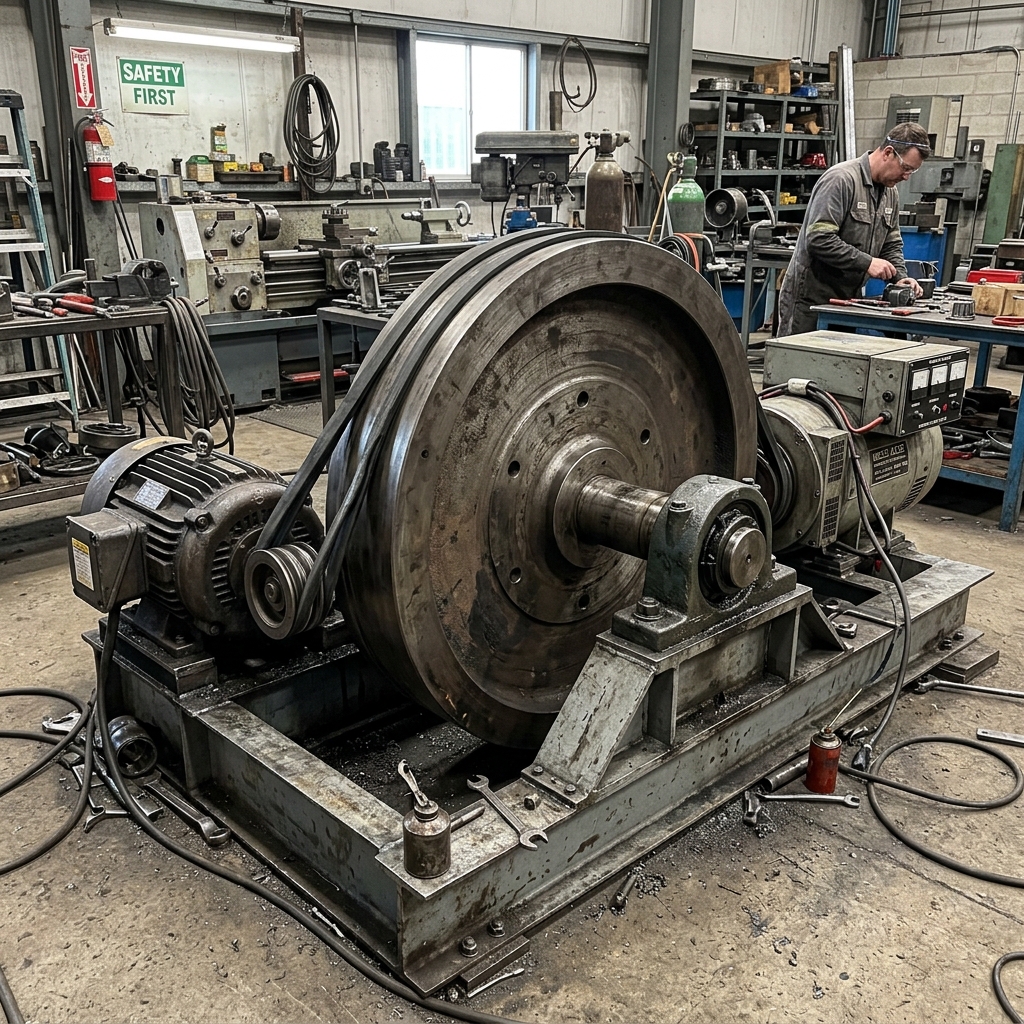 Figure: Chas Campbell Flywheel Generator schematic layout from Patrick Kelly\'s Guide
⚠️ Unverified or Disputed Media Archive
The following media assets associated with this device have low verification confidence, lack clear copyright licensing, are AI-generated, or are contextually disputed.
🤖 AI GENERATEDHistorical rendering of the campbell-flywheel.
Reported Source: Local Generated Media Archive
License: FAIR_USE (COMMENTARY_ONLY)
Discussions
View all →No discussions yet. Be the first to start one!
🔧 Key Components
- •AC mains motor (fractional HP)
- •Gear train with belt pulleys (3:1 to 4:1 ratio)
- •Heavy flywheel (10+ kg, preferably 20+ kg)
- •Generator/alternator
- •Drive belts (deliberately oversized for slack)
- •Sturdy frame/base
⚠️ Safety
Heavy spinning flywheel must be properly guarded. Belt drives can catch clothing/fingers.
Categories
🛠️ Construction Manual
A complete, step-by-step replication manual is available for this device. Sourced from public archives.
📥 Download Full Manual (PDF)🏛️ Historical Forum Archive
Preserved threads from the legacy Overunity.com community relating to this device:
📖 Patrick Kelly Guide
The complete chapter reference text and schematic diagram are embedded directly in the main section of this page.