Tesla Bifilar Pancake Coil & Radiant Energy
by Nikola Tesla · USA/Serbia · 1894
Safety & Liability Disclaimer
Replicating alternative electromagnetism or mechanical resonance systems carries extreme physical hazards including lethal voltage shock, explosive gas ignition, mechanical shrapnel, and chemical toxicity. All contents, schematics, and guidelines on this page are provided strictly for educational and historical research.
Device-Specific Hazards:
At resonance, voltages can reach thousands of volts even from low-voltage sources. Treat all resonant coil experiments with high-voltage caution.
By viewing or constructing any design herein, you agree to assume 100% of all risks and to indemnify and hold harmless the site owners, authors, and contributors. Read our complete, legally binding Safety & Liability Disclaimer.
Overview
Two wires wound in parallel as a flat spiral (pancake) coil, connected end-to-beginning to maximize self-capacitance and self-inductance. At its natural resonant frequency, the coil exhibits dramatic voltage multiplication. Used in circuits designed to capture back-EMF 'radiant energy' from collapsing magnetic fields. The foundational Tesla technology underlying many other devices.
⚖️ What Would Convince Us?
To validate the anomalies claimed for this device under mainstream scientific parameters, builders and inventors must document and present evidence satisfying the following criteria:
Closed-loop operational testing proving net-positive work output
Calibrated calorimetry auditing tracking total heat dissipation
Independent replication by an unaffiliated research laboratory
Investigation & Credibility Metrics
Sources are not verified or currently undergoing archive indexing.
Claimed overunity/propulsion has not been verified in a control lab.
No third-party replication attempts have been documented.
No measurement details or instrumentation list were provided.
This device is purely open-source or historical; no active sales.
How It Works
The bifilar winding creates a coil where adjacent turns have maximum voltage difference, creating high distributed capacitance. This makes the coil a self-resonant LC circuit. When driven at its resonant frequency, voltage multiplication occurs (similar to a tank circuit). The high Q-factor means energy oscillates with minimal loss.
Community Status
The foundational Tesla technology. Easy to build and genuinely interesting resonance behavior is observed. Great learning project with real physics. Overunity claims are attributed to measurement limitations with high-frequency reactive power.
🔧 Build Guides
⚠️ CRITICAL SAFETY WARNING
DANGER: LETHAL VOLTAGE, EXPLOSIVE GASES, AND HIGH-VELOCITY PROJECTILES.
This document is a historical archive of unverified claims, NOT a set of instructions. Enmagx and its creators take zero responsibility for injury, death, or property damage resulting from attempting to replicate these theoretical devices.
Proceed for historical research purposes only. Do not attempt to build without professional engineering supervision.
📺 Video & External References
🔗 Step-by-Step Construction Guides & Forums
Original 1894 patent drawings showing the end-to-beginning junction wiring.
Hobbyist guide showing flat concentric spiral coil winding techniques using acrylic plates.
📖 Patrick Kelly Guide: Technical Assessment
Chapter 5 REFERENCE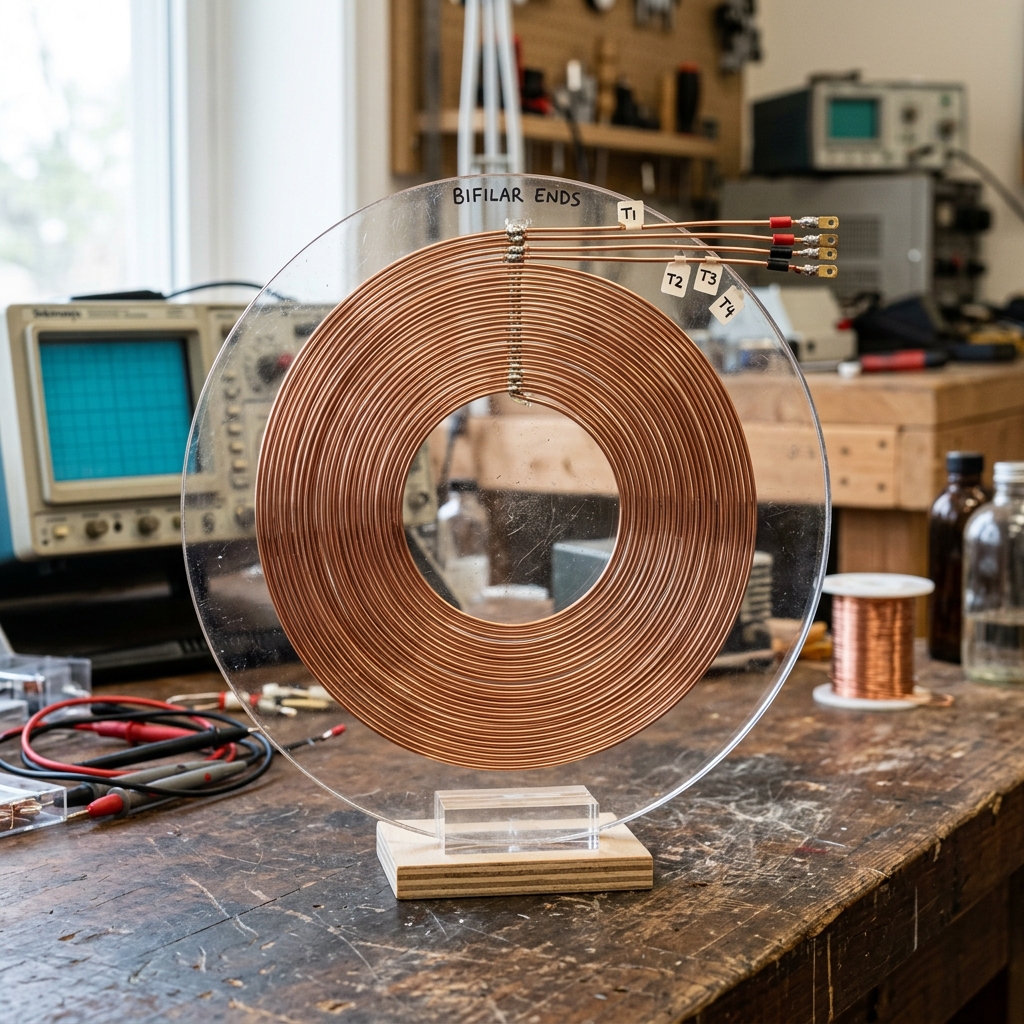 Figure: Tesla Bifilar Pancake Coil & Radiant Energy schematic layout from Patrick Kelly\'s Guide
⚠️ Unverified or Disputed Media Archive
The following media assets associated with this device have low verification confidence, lack clear copyright licensing, are AI-generated, or are contextually disputed.
🤖 AI GENERATEDHistorical rendering of the tesla-bifilar.
Reported Source: Local Generated Media Archive
License: FAIR_USE (COMMENTARY_ONLY)
Discussions
View all →No discussions yet. Be the first to start one!
🔧 Key Components
- •Magnet wire (various gauges)
- •Flat winding form (plywood, acrylic, or 3D printed)
- •Signal generator
- •MOSFET driver or amplifier
- •Oscilloscope (essential for measurement)
- •Capacitors for tuning
📄 Patents
⚠️ Safety
At resonance, voltages can reach thousands of volts even from low-voltage sources. Treat all resonant coil experiments with high-voltage caution.
Categories
🛠️ Construction Manual
A complete, step-by-step replication manual is available for this device. Sourced from public archives.
📥 Download Full Manual (PDF)📖 Patrick Kelly Guide
The complete chapter reference text and schematic diagram are embedded directly in the main section of this page.